How does an op amp work? How do I use an op amp
How does an op amp work? How do I use an op amp
These are questions that I have asked at two periods in my life. The
first time was in my introductory circuits class and around that time I
really didn’t care (beer was a priority). The second time was when I
dove headfirst back into
analog electronics for
my new job and had to
re-teach myself a lot of things. I really appreciate the opportunity I had to re-learn everything because the second time around, I think I got it right.
OK, so
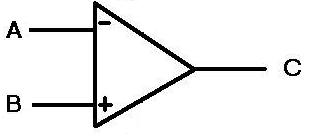
let’s start simple. What is an op amp? Whoa, loaded question. For our purposes here (and just for now), let’s say it’s just a symbol.

Figure 1: Just a symbol folks, nothing to see here
To keep things basic, the A & B points are the input, the C point
is the output.This symbol is an IDEAL op-amp, meaning it is impossible
to construct one and really the expectations for the op amp are
unrealistic. But this is the internet and we can do what we want on the
internet, so we’ll just use the IDEAL op-amp for now.

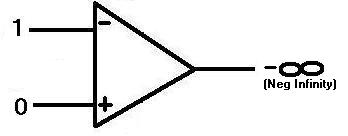
Figure 2: Inverting Ideal Op-amp
OK, so now you know what the symbol is, but what does it mean? Well,
the idea is you put two electrical signals into the inputs then the
output changes accordingly. It takes the difference between the inputs
and amplifies it, hence operational amplifier, or op amp. You may have
noticed that input A has a minus symbol and input B has a plus symbol.
So let’s say that the input to the minus, or INVERTING, input is 1 (for
simplicity’s sake…
this site is about analog
so that value could be ANYWHERE from 0 to 1 or higher! Just thought I’d
mention that). The input to the plus, or NON-INVERTING, input is 0. Now
the op-amp is in an unbalanced state. The device is designed so that
when this happens, the output goes as negative as it can. For the ideal
case, we say this is negative infinity, but that’s not really possible.
More on that later.

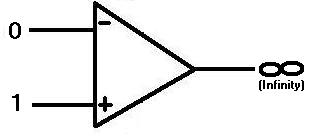
Figure 3: Non-inverting Ideal Op-amp
Conversely, in figure 3, if we put a one on the non-inverting and a
zero on the inverting input, the op amp output would go high, infinity
for our purposes here. The important thing to know is this:
The op-amp always “wants” both
inputs (inverting and non-inverting) to be the same value. If they are
not, the same value, the op amp output will go positive or negative,
depending on which input is higher than the other.
(Throughout this article I will continue to anthropomorphize op amps…best to get used to it now)
Alright, so how do we use this in circuits? If we wanted to find out
if two signals were different, we could tie the signals to the inputs of
the op amp, but then the output would go to infinity. This would not do
us any good. The answer to this and
many other questions
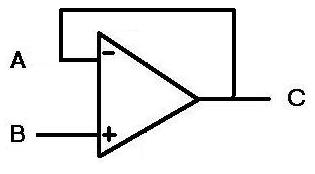
in the universe is feedback. We are going to take the output and tie it
back to the inverting input. Now the circuit looks like this:

Figure 4: A buffer
First, we assume that the circuit has all points start at zero (point A being the most important). Next, we put a value of
1
(like the picture in figure 2) at the “B” non-inverting input. “WHOA,”
says the op amp, “THIS AIN’T RIGHT!” So now the op amp puts its output
to as high as it can, as fast as it can. This feeds back from the output
(“C”) to the inverting input (“A”). So as the output moves closer to 1,
the op amp is happier and backs off the output. When the input at A is
the same as at B, the op amp is happy and stays there (but maintains the
output of 1). The key here is that the op amp moves as fast as possible
to get both inputs to be the same.
Why would someone use a buffer? Well that brings us to the next point about op amps, specifically ideal op amps:
Ideal op amps have infinite impedance (resistance) at their inputs. This means that no current will flow into the op amp.
A common use for a buffer is to supply current to another stage of a
design, where the buffer acts as a gateway. So when the buffer “sees” a
voltage at the input (“B”), it will output the voltage at “C”, but will
also drive that voltage with current (as much as you want for an ideal
op amp). This would be useful if you have a weak signal at the input,
but want to let some other part of a circuit know about it. Perhaps you
have a small sensor that is outputting a small voltage, but then you
want to send the voltage over a long wire. The resistance in the wire
will probably consume any current the sensor is outputting, so if you
put that signal through a buffer, the buffer will supply the necessary
current to get the signal to its destination (the other end of the
wire).
What if the signal coming from the sensor is too small though? What
if we want to make it bigger? This is when we turn the op amp into an
amplifier, using resistors. One of the more common ways of doing so is
using the inverting input, shown below:

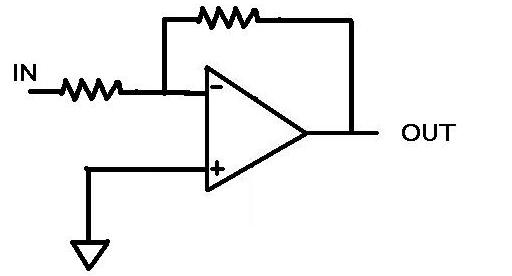
Figure 5: Inverting op-amp
Let’s go over what we know about this circuit. We know that the op
amp wants both inputs to be the same. We also know that the
non-inverting input is zero (because it’s connected to ground) and so
the op amp will want the inverting input to be equal to zero (sometimes
known as a “virtual ground”). In fact, since the op amp has feedback
through the top resistor (squiggly line if you didn’t know), then the
(ideal) op amp will output just about any current and voltage in order
to get the inverting input to be equal to zero.
So now our situation.
A dashing young engineer
hooks up a voltage source to the point “IN” set to 1 volt. This creates
a voltage at the inverting input. “WHOA” says the op amp, and then it
begins to output a voltage to make the inverting input point equal to
zero. Since the input is 1 volt the op amp decides it better do the
opposite in order to make the inverting input match the non-inverting
input of zero. As fast as it can (infinitely fast for an ideal op amp),
it outputs -1 volt. The inputs are both zero and everything is right in
the op amp’s world. What about current though? We remember that current
cannot flow into the op amp at the inverting input, so any current will
be flowing through both resistors. If we have 1 volt at the input and a 1
ohm resistor at the input, then we will have 1 amp of current flowing
(according to Ohm’s law V=IR). So when the op amp outputs -1 volt across
the top resistor, there is a -1 amp going through it (assuming it is a 1
ohm resistor). The currents cancel each other out at the inverting
input and the voltage then equals zero. The place where the currents
meet is sometimes called the “summing node”. This is a useful
representation when dealing with currents as opposed to voltages.
For the last part of this thought exercise, let’s look at a situation
where the resistors at the input and at the top of the circuit are not
the same. Similarly to above, the same dashing young engineer puts 1
volt at the “In” node. The resistor is still 1 ohm, so there is 1 A of
current flowing through to the summing node. The op amp once again sees
this 1 volt and once again says “WHOA, I’m unhappy about this” and
starts outputting the highest voltage it can. However, in this
situation, the top resistor is now 4 ohms. In order to create the -1 amp
that is required to cancel the 1 amp going through the input resistor,
the op amp must output -4 volts (remember V=IR). We see that for an
inverting op amp configuration, the ratio of the resistance of the top
resistor to the bottom resistor determines the gain, or a multiplication
factor from the input to the output. Also notice that the output is
negative for a positive input, confirming that this is an inverting
amplifier.
That’s the basics of it. Check back here for
more about op amps, because there is a lot more to be said.
Future posts might include other op amp configurations,
design considerations and even the dreaded “REAL WORLD”, where the ideal op amp no longer exist.